
Introduction
For many beginners, the biggest obstacle to entering the real estate market is financing. Buying an investment property requires capital, and new investors often assume they must have a large amount of cash before they can start. However, real estate experts know that there are multiple financing strategies that make property investing possible even for those with limited savings.
Financing a first investment property is not only about getting a loan. It involves understanding different funding options, evaluating risks, and choosing the strategy that best matches your financial situation. The right financing method can help beginners enter the market faster while still maintaining financial stability.
Many successful investors began their real estate journey using creative financing techniques. From traditional bank mortgages to partnerships and government-backed loans, there are numerous ways to secure funding for an investment property.
By learning these smart financing methods, beginners can turn the dream of owning an investment property into reality and start building long-term wealth through real estate.
Understanding Real Estate Investment Financing
Before exploring specific financing options, beginners must understand how property investment financing works. Real estate financing involves borrowing money or using financial resources to purchase property while planning to repay that money over time.
Most investors rely on loans to acquire properties because it allows them to control valuable assets without paying the full price upfront. This concept is known as leverage in real estate.
Understanding leverage helps investors realize that property investing does not always require full cash payment. Instead, it requires careful planning and a strategy that ensures the property generates enough income to cover the financing costs.
When beginners understand this principle, they gain confidence in exploring different funding options available in the real estate market.
Traditional Bank Mortgages
A traditional mortgage is one of the most common ways beginners finance their first real estate investment property. Banks and financial institutions offer loans that allow buyers to pay a percentage of the property price as a down payment while borrowing the remaining amount.
Mortgage loans typically offer structured repayment plans with fixed or variable interest rates. These loans can extend over many years, making monthly payments more manageable.
Lenders usually evaluate factors such as credit score, income stability, and existing debts before approving a mortgage. A strong financial profile improves the chances of receiving better loan terms.
For many beginner investors, a bank mortgage provides a reliable and structured way to enter the property investment market.
Government Backed Loan Programs
Many governments offer special loan programs designed to help individuals purchase property. These programs often require lower down payments and provide favorable interest rates compared to traditional loans.
Government-backed financing options can make real estate investing more accessible for beginners who may not have significant savings.
Some programs are specifically designed for first-time property buyers and may include benefits such as reduced loan insurance or flexible repayment terms.
Exploring these programs can open doors to affordable financing opportunities that many new investors overlook.
Using Personal Savings for Down Payments
While loans are commonly used for property purchases, personal savings still play an important role. Most lenders require a down payment before approving a mortgage.
Saving for a down payment demonstrates financial discipline and reduces the overall loan amount required. A larger down payment can also lead to better interest rates and lower monthly payments.
Beginners should create a dedicated savings plan that gradually builds the funds needed for their first property investment.
Using personal savings responsibly provides a strong financial foundation for future real estate investments.
Partnering with Other Investors
Real estate partnerships allow beginners to combine resources with other investors. Instead of financing a property alone, two or more individuals share the costs, risks, and profits.
This strategy makes it possible to purchase higher-value properties that might otherwise be out of reach for a single investor.
Partnerships also allow beginners to learn from more experienced investors who bring valuable knowledge and expertise.
However, clear agreements and legal contracts are essential to ensure that responsibilities, profits, and ownership shares are clearly defined.
Private Money Lenders
Private lenders are individuals or groups who provide loans to real estate investors outside of traditional banking institutions. These lenders often offer more flexible approval processes than banks.
Private money loans may be based more on the property’s investment potential rather than the borrower’s credit history.
Although interest rates may be higher than traditional mortgages, private lenders can provide faster approvals and fewer bureaucratic requirements.
For beginners who need quick financing, private lenders can be a useful option when used carefully.
Hard Money Loans
Hard money loans are short-term financing options commonly used in real estate investing. These loans are usually provided by private companies that specialize in property investment lending.
Hard money lenders focus primarily on the property’s value rather than the borrower’s financial background. This makes them attractive to investors who may not qualify for traditional loans.
However, hard money loans typically come with higher interest rates and shorter repayment periods.
Investors often use this type of financing for property renovations or quick resale opportunities.
Home Equity Financing
Investors who already own property can use their home equity to finance another investment. Home equity loans or lines of credit allow homeowners to borrow against the value of their existing property.
This strategy provides access to funds that can be used as a down payment or even for full property purchases.
Home equity financing often offers lower interest rates compared to other borrowing options.
However, investors must be cautious because the existing property serves as collateral for the loan.
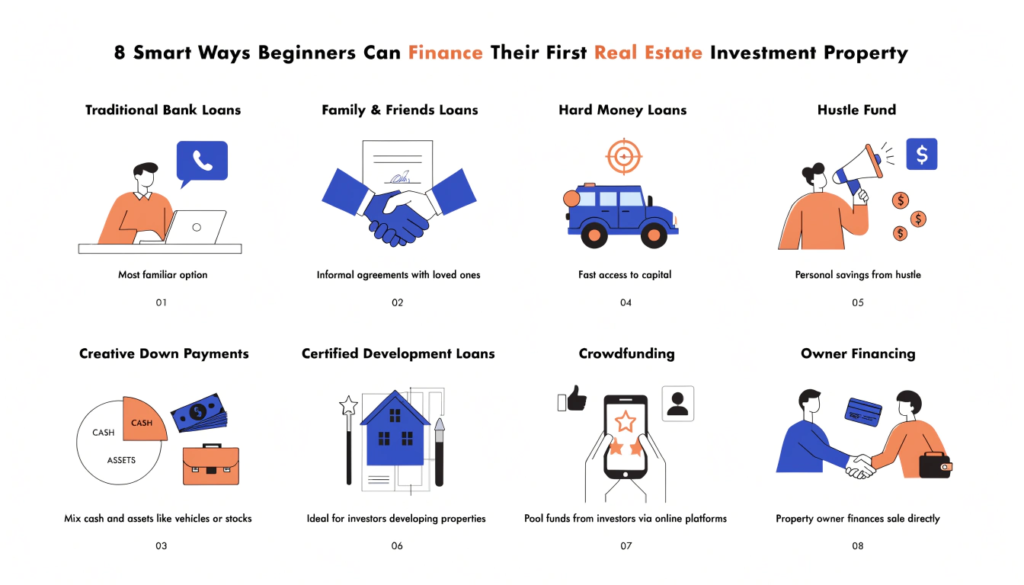
Seller Financing Opportunities
Seller financing occurs when the property seller acts as the lender for the buyer. Instead of obtaining a loan from a bank, the buyer makes payments directly to the seller over time.
This arrangement can benefit both parties. Buyers may receive more flexible terms, while sellers earn interest on the loan.
Seller financing is particularly common when properties remain unsold for extended periods or when buyers have difficulty qualifying for traditional loans.
Negotiating favorable terms can make this financing method highly attractive for beginners.
Real Estate Investment Groups
Real estate investment groups allow individuals to invest in property collectively. Members contribute funds that are used to purchase and manage real estate assets.
This approach allows beginners to participate in property investments without managing properties themselves.
Professional managers typically handle tenant relations, maintenance, and financial operations.
For beginners who prefer a hands-off investment approach, these groups provide an opportunity to gain exposure to real estate markets.
Real Estate Crowdfunding Platforms
Crowdfunding has become an increasingly popular way to finance property investments. Online platforms allow multiple investors to contribute small amounts of capital toward larger real estate projects.
This method lowers the financial barrier for beginners who cannot afford to purchase entire properties on their own.
Investors receive returns based on the performance of the real estate project.
Crowdfunding offers a modern and flexible approach to property investment financing.
Improving Your Credit Score
Credit scores play a significant role in determining loan approval and interest rates. Investors with higher credit scores usually qualify for better financing terms.
Improving credit scores involves paying bills on time, reducing existing debt, and maintaining a healthy credit history.
A strong credit profile increases the likelihood of securing favorable mortgage agreements.
For beginners planning to invest in property, strengthening credit should be an important financial goal.
Building Strong Financial Documentation
Lenders typically require detailed financial documentation before approving loans. These documents may include income statements, tax returns, bank statements, and employment records.
Providing clear and organized financial information demonstrates reliability and financial stability.
Investors who prepare these documents in advance can streamline the loan approval process.
Strong financial documentation improves credibility and increases financing opportunities.
Choosing the Right Loan Structure
Different loan structures offer varying advantages. Some mortgages provide fixed interest rates that remain constant throughout the loan period, while others have adjustable rates.
Fixed-rate loans provide predictable monthly payments, making budgeting easier.
Adjustable-rate loans may start with lower interest rates but can increase over time.
Understanding these differences helps investors select financing options that match their financial strategy.
Calculating Cash Flow Before Borrowing
Before accepting any loan, investors must calculate whether the property can generate enough rental income to cover expenses.
Cash flow analysis includes mortgage payments, maintenance costs, taxes, and insurance.
Positive cash flow ensures that the investment remains financially sustainable.
Careful calculations help investors avoid financing properties that create financial losses.
Creating a Long Term Financing Plan
Successful investors think beyond their first property purchase. Developing a long-term financing plan allows them to expand their property portfolio gradually.
This plan may include strategies for refinancing properties, reinvesting profits, or securing additional loans.
A structured financial roadmap ensures that each investment contributes to overall wealth-building goals.
Long-term planning transforms property investing into a sustainable financial strategy.
Understanding Loan Risks
Borrowing money always carries financial risk. Investors must consider potential challenges such as rising interest rates, property vacancies, or unexpected repair costs.
Understanding these risks allows investors to prepare contingency plans.
Maintaining financial reserves and conservative borrowing practices helps protect investments during difficult periods.
Responsible borrowing is essential for long-term real estate success.
Working with Experienced Lenders
Building relationships with experienced lenders can provide valuable advantages. Lenders who understand real estate investing may offer guidance and flexible loan structures.
These professionals can also help investors identify financing solutions tailored to their specific goals.
A strong relationship with lenders improves access to future financing opportunities.
This professional support can accelerate portfolio growth.
Learning from Successful Investors
Studying experienced investors provides valuable insights into financing strategies. Many successful property investors share their experiences through books, seminars, and mentorship programs.
Learning from real-world examples helps beginners understand practical financing methods.
This knowledge allows investors to avoid common mistakes and make smarter financial decisions.
Continuous learning strengthens investment confidence and competence.
Starting Small and Growing Gradually
Beginners often feel pressure to pursue large property investments immediately. However, starting with a smaller investment can provide valuable experience.
Smaller properties require less financing and carry lower financial risk.
As investors gain knowledge and build equity, they can gradually expand their portfolios.
This step-by-step approach ensures sustainable growth in the real estate market.
Conclusion
Financing the first real estate investment property may seem challenging for beginners, but numerous options make it possible to enter the market. From traditional bank mortgages and government-backed loans to partnerships, crowdfunding, and private lenders, investors have multiple strategies available.
The key to successful financing lies in careful planning, financial discipline, and thorough research. By improving credit scores, understanding loan structures, and analyzing property cash flow, beginners can choose financing methods that support long-term financial stability.
Real estate investing is not limited to wealthy individuals. With the right knowledge and financing strategies, beginners can start building a property portfolio that generates consistent passive income and long-term wealth.
FAQs
What is the easiest way for beginners to finance a property investment?
A traditional mortgage with a reasonable down payment is often the most accessible option for beginners.
Can I invest in property without large savings?
Yes, options such as partnerships, crowdfunding, and certain loan programs allow investors to start with smaller amounts of capital.
Do lenders check credit scores for investment property loans?
Yes, credit scores are an important factor lenders consider when evaluating loan applications.
Is seller financing safe for beginners?
Seller financing can be beneficial if the agreement is properly structured and legally documented.
How much down payment is usually required?
Most investment property loans require a down payment between 10% and 25%, depending on the lender and loan type.