
Introduction
Real estate investing is often associated with buying rental homes, commercial buildings, or flipping properties for quick profit. While these traditional strategies can be profitable, many investors focus only on the most obvious opportunities and overlook several hidden areas of the real estate market. These overlooked opportunities can sometimes provide even better returns with less competition.
Experienced investors know that the real estate market is full of unique possibilities. Some opportunities exist in emerging neighborhoods, underutilized properties, or creative investment strategies that most beginners never consider. By exploring these hidden paths, investors can find properties with strong growth potential before the majority of the market notices them.
The key to successful investing is recognizing value where others fail to look. Investors who think creatively and conduct thorough research often discover opportunities that offer both strong rental income and long-term appreciation.
Understanding these lesser-known real estate opportunities can help investors diversify their portfolios, reduce competition, and unlock new sources of wealth. The following insights reveal several hidden opportunities that many property investors often miss.
Recognizing Hidden Opportunities in Real Estate Markets
Many investors limit their property search to traditional residential homes or popular neighborhoods. However, hidden opportunities often exist in areas or property types that receive less attention. Recognizing these opportunities requires curiosity and a willingness to explore beyond the obvious choices.
Investors who study local development plans, population trends, and economic changes can often identify areas with strong future potential. These locations may currently be undervalued but can grow significantly over time.
Understanding how to spot these hidden opportunities allows investors to purchase properties before demand increases. This strategy can result in higher profits and stronger long-term investment returns.
Investing in Emerging Neighborhoods
Emerging neighborhoods often offer some of the best hidden investment opportunities. These areas may currently have lower property prices but show signs of future growth due to new infrastructure, business developments, or population increases.
Investors who identify these areas early can purchase properties at affordable prices before the market becomes competitive. Over time, property values may rise significantly as more people move into the neighborhood.
Researching city planning projects, transportation expansions, and commercial developments can help investors identify neighborhoods that are likely to experience rapid growth.
This strategy requires patience, but it can generate impressive returns for forward-thinking investors.
Exploring Distressed Properties
Distressed properties are homes or buildings that are being sold due to financial difficulties, foreclosure, or neglect. Many investors avoid these properties because they require repairs or renovations.
However, experienced investors often see opportunity where others see problems. Purchasing distressed properties at lower prices allows investors to renovate them and increase their market value.
After improvements, these properties can either be rented for consistent income or sold for profit.
Distressed property investing requires careful inspection and budgeting, but it can offer significant financial rewards.
Converting Properties for Multiple Uses
Some properties have the potential to serve multiple purposes, but investors fail to recognize their flexibility. For example, a large residential home might be converted into multiple rental units.
Similarly, unused commercial spaces can be transformed into coworking spaces, small offices, or short-term rental accommodations.
Creative property conversion increases the income potential of a single investment.
Investors who think creatively about property use can unlock additional revenue streams that many others overlook.
Investing in Vacation Rental Properties
Vacation rental properties have become increasingly popular due to the growth of online booking platforms. Properties located in tourist destinations can generate significant short-term rental income.
Unlike traditional long-term rentals, vacation rentals often produce higher nightly rates. This can result in greater annual profits if the property maintains high occupancy levels.
Investors must carefully research local tourism demand and regulations before entering this market.
When managed properly, vacation rentals can become highly profitable investment opportunities.
Purchasing Properties with Development Potential
Some properties may appear ordinary but offer significant development potential. For example, a small building located on a large piece of land may allow for future expansion.
Investors who purchase these properties can later develop additional units, increasing both rental income and property value.
Understanding zoning regulations and local development plans helps investors identify properties suitable for expansion.
This strategy can transform a modest investment into a highly valuable real estate asset.
Exploring Commercial Real Estate Niches
Commercial real estate offers many niche opportunities that investors often overlook. Small retail spaces, storage facilities, and medical offices can generate reliable rental income.
These properties often have longer lease agreements than residential rentals, providing stable cash flow.
Investors who explore specialized commercial sectors may face less competition than those focused solely on residential properties.
Understanding the needs of local businesses can help identify commercial properties with strong demand.
Investing in Student Housing
Properties located near universities often have consistent rental demand from students. Student housing can provide reliable income because new groups of students arrive each academic year.
While student tenants may require more active management, the demand for housing near campuses rarely disappears.
Investors can maximize profits by renting rooms individually rather than leasing the entire property to one tenant group.
Student housing investments can be particularly profitable in cities with large universities.
Acquiring Properties Through Auctions
Real estate auctions provide another hidden opportunity for investors seeking discounted properties. Auctioned properties are often sold quickly due to financial distress or legal circumstances.
Investors who conduct proper research before bidding may acquire valuable properties at lower prices.
However, auction purchases require careful preparation because buyers usually have limited time to inspect properties.
With the right strategy, property auctions can become a powerful tool for acquiring profitable investments.
Investing in Fix and Rent Strategies
Many investors focus on the popular fix-and-flip strategy, where a property is renovated and quickly sold. However, another approach is the fix-and-rent strategy.
In this model, investors renovate a property and then rent it out for long-term income rather than selling it immediately.
This approach allows investors to benefit from both rental income and long-term property appreciation.
Fix-and-rent investments can build sustainable passive income over time.
Leveraging Mixed Use Properties
Mixed-use properties combine residential and commercial spaces within a single building. For example, a building may have retail shops on the ground floor and apartments above.
These properties offer multiple income streams from different types of tenants.
If one sector experiences reduced demand, the other may continue generating income.
Mixed-use investments provide diversification and can create strong financial stability.
Identifying Underpriced Rental Markets
Some rental markets remain undervalued due to lack of investor attention. These markets may offer strong rental demand but lower property purchase prices.
Investors who identify these areas early can achieve higher rental yields compared to more competitive markets.
Researching migration patterns and job growth can help locate such opportunities.
Lower competition often allows investors to negotiate better property deals.
Investing in Storage Facilities
Self-storage facilities have become increasingly popular as urban populations grow and living spaces become smaller.
These properties require relatively low maintenance compared to residential buildings.
Storage units can generate steady income from monthly rental fees.
Investors who explore this niche market may discover consistent demand and stable returns.
Exploring Short Term Rental Arbitrage
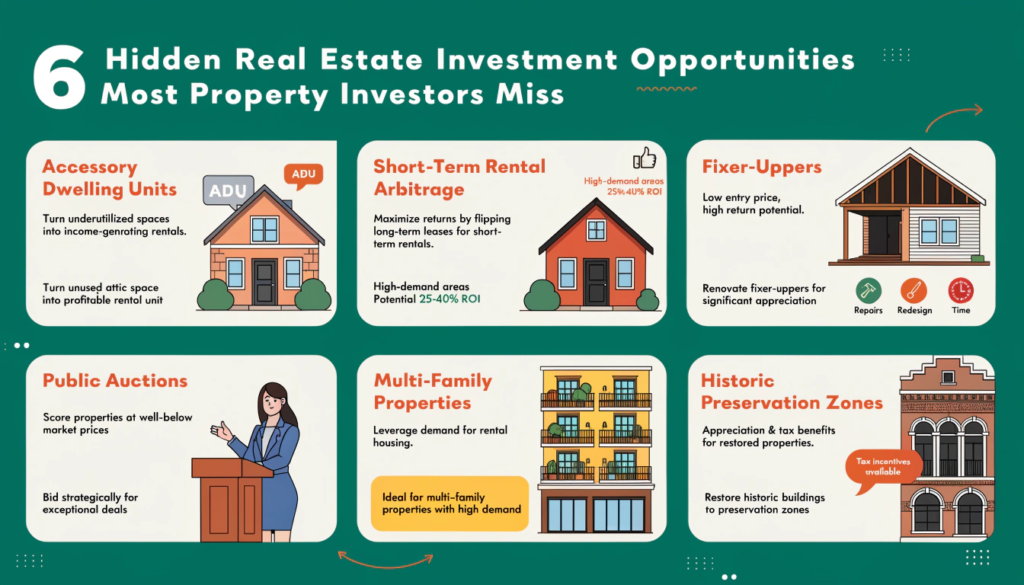
Rental arbitrage involves leasing a property long-term and then renting it out as a short-term rental.
This strategy allows investors to generate income without purchasing property.
However, investors must ensure local regulations allow short-term rentals.
When executed properly, rental arbitrage can produce strong profits with minimal initial investment.
Targeting Workforce Housing
Workforce housing refers to affordable rental properties designed for middle-income workers.
These properties often experience high demand in growing cities where housing costs are increasing.
Investors who focus on this segment may benefit from stable tenant demand.
Workforce housing can provide reliable long-term rental income.
Buying Land in Growing Areas
Raw land is often overlooked by investors who focus only on developed properties.
However, land located near expanding cities or infrastructure projects may increase significantly in value.
Investors can hold land for future development or sell it once demand rises.
Land investments require patience but can produce substantial returns.
Exploring Government Surplus Properties
Government agencies sometimes sell surplus properties that are no longer needed for public use.
These properties may be offered at competitive prices to encourage development.
Investors who monitor government property sales may find unique opportunities.
Such investments often require renovation or redevelopment but can provide excellent value.
Identifying Off Market Deals
Off-market properties are not publicly listed for sale. Investors who build strong networks with real estate agents and property owners may discover these hidden deals.
Because fewer buyers know about these opportunities, competition is lower.
Off-market deals often allow investors to negotiate favorable purchase prices.
Networking and relationship-building are key to finding these hidden opportunities.
Repositioning Older Properties
Older properties in established neighborhoods may require modernization to meet current market expectations.
Investors who renovate outdated properties can increase both rental income and property value.
Upgrading kitchens, bathrooms, and energy efficiency features can significantly improve market appeal.
Repositioning older properties transforms neglected assets into valuable investments.
Thinking Creatively About Real Estate Investments
The most successful real estate investors often think creatively and remain open to unconventional opportunities.
Instead of following the crowd, they explore alternative strategies, property types, and markets.
Creative thinking allows investors to discover opportunities others overlook.
This mindset can lead to unique investments that generate strong financial returns.
Conclusion
The real estate market offers far more opportunities than most investors realize. While traditional strategies like rental homes and property flipping remain popular, many hidden opportunities exist for those willing to explore beyond conventional approaches.
By researching emerging neighborhoods, exploring distressed properties, considering mixed-use investments, and identifying undervalued markets, investors can uncover opportunities with strong profit potential. Creative thinking and thorough research allow investors to discover properties that others may overlook.
Real estate success often comes from recognizing value where others fail to look. Investors who remain open to new strategies and continuously study market trends can build diverse portfolios and achieve long-term financial growth.
FAQs
What are hidden real estate investment opportunities?
These are less obvious property investments that many investors overlook, such as emerging neighborhoods, mixed-use properties, or off-market deals.
Are distressed properties good investments?
Yes, distressed properties can be profitable if purchased at the right price and renovated properly.
What is an off-market real estate deal?
An off-market deal is a property sale that is not publicly advertised and is often discovered through networking.
Is land a good real estate investment?
Land can be a strong long-term investment, especially in areas expected to experience future development.
How can beginners find hidden real estate opportunities?
Beginners can research local markets, build relationships with agents, monitor auctions, and study development trends.